


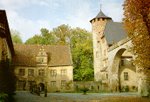
The word “schloss” is loosely translated “castle. There are a variety of castles throughout Europe but this “schloss” is a dwelling place set aside for royalty. These castles were known for their beauty and for the large grounds surrounding the castle. These “schlosses” came with a certain prestige and usually indicated that wealthy families owned them. The grounds were large enough for hunting and for holding lavish social occasions. They were normally placed high on a hill so that it was easy to observe any visitors or troops that may have come into the area.
I did discover that the word “Torbogen” had a Swiss derivation and after some more research I found out that the translation for the word was “archway”. There is an archway that extends from one part of the castle to the other side and there is a walkway above the arch where soldiers could observe any action below.
Thursday, August 21, 2008

THE PENCIL ETCHING
It is hard to describe the detail in the picture but it certainly took quite some time from start to finish unless the person was an accomplished artist. The drawing shows the archway extending from the castle area to the other part of the residence. There is what appears to be an ironwork fence above the archway to protect anyone walking the sentry point.
Just before the courtyard and directly in front of the archway is a fountain. It appears to be concrete. One side of the fountain is partially torn down, probably due to the elements of time or possibly awaiting reconstruction. To the left of the fountain is a man that is walking a dog towards the castle who I assume is the baron himself. The area directly to the castle is partially obscured with trees as a camouflage to prevent soldiers from noticing it.
Just before the courtyard and directly in front of the archway is a fountain. It appears to be concrete. One side of the fountain is partially torn down, probably due to the elements of time or possibly awaiting reconstruction. To the left of the fountain is a man that is walking a dog towards the castle who I assume is the baron himself. The area directly to the castle is partially obscured with trees as a camouflage to prevent soldiers from noticing it.
BRIEF OVERVIEW
The information that I gleaned gave me not only a better understanding of the war but also the part that the castle played in Dad’s life. Many of us have not been actively involved in war, but the fighting and battles of World War II were a very important part of history. Stopping the German invasion into European countries and ending the horrors of the Holocaust were very real parts of the offensive. So many suffered as a result of the World War II but with the end of the war in 1945 people could begin to rebuild their lives. Other military actions followed this war, but this war has been a part of my own life since more than one family member was actively participated in the war.
Tuesday, August 19, 2008
CROSSING THE RHINE: LATE 1945
***Every attempt has been made to be accurate. If there are errors, please let me know.
June 5 to 10, 1945: Somewhere during these dates the troops move to Allendorf, Germany which is located in the area of Hesse Germany between Frankenberg and Battenberg.
June 1945: Entry into Cologne; built the pontoon bridge across the Rhine. Soldiers received a bronze star for their efforts.
June 10, 1945: Invasion into southern Holland (Valkenburg) bordered by Germany and Belgium; Allies overcome enemy and Remagen Bridge is destroyed.
June 5 to 10, 1945: Somewhere during these dates the troops move to Allendorf, Germany which is located in the area of Hesse Germany between Frankenberg and Battenberg.
June 1945: Entry into Cologne; built the pontoon bridge across the Rhine. Soldiers received a bronze star for their efforts.
June 10, 1945: Invasion into southern Holland (Valkenburg) bordered by Germany and Belgium; Allies overcome enemy and Remagen Bridge is destroyed.
A NIGHT IN THE CASTLE
OCTOBER 1945
Allies enter into Germany by crossing the Rhine River. Soldiers occupy Furstenau castle immediately after the Germans leave the area.
From a vantage point in the forested area, German soldiers heard the shots of the GI’s and knew that their location was compromised. Since the war had already been officially declared over, the Germans quickly moved further into Germany hoping to escape any more direct confrontation with the Allied forces.
With only a few casualties, the Americans claimed the victory. It was only a short distance to the castle that loomed ahead in the distance. It would be a safe place to spend the night. It was a simple yet elaborate castle but it provided shelter. Soldiers looked at the ransacked interior and found some interesting items to keep. A couple of Nazi knives, some German music taken off the piano stand, and a German rifle left behind in haste were just some of the spoils of war. An old picture of the castle hung over the fireplace and words in German indicated that it was the castle of Baron Von Fursteneau. Every man found something to claim and keep. But with all the spoils that were confiscated that evening nothing anything that was taken that night paled in comparison to the victory that the Americans achieved.
Allies enter into Germany by crossing the Rhine River. Soldiers occupy Furstenau castle immediately after the Germans leave the area.
From a vantage point in the forested area, German soldiers heard the shots of the GI’s and knew that their location was compromised. Since the war had already been officially declared over, the Germans quickly moved further into Germany hoping to escape any more direct confrontation with the Allied forces.
With only a few casualties, the Americans claimed the victory. It was only a short distance to the castle that loomed ahead in the distance. It would be a safe place to spend the night. It was a simple yet elaborate castle but it provided shelter. Soldiers looked at the ransacked interior and found some interesting items to keep. A couple of Nazi knives, some German music taken off the piano stand, and a German rifle left behind in haste were just some of the spoils of war. An old picture of the castle hung over the fireplace and words in German indicated that it was the castle of Baron Von Fursteneau. Every man found something to claim and keep. But with all the spoils that were confiscated that evening nothing anything that was taken that night paled in comparison to the victory that the Americans achieved.
THE GLOWING CHIPS: AN INTERESTING ACCOUNT
STORY
Rain poured down in steady sheets and the red clay ground became muddy, so muddy that boots sunk into the red ground and stuck to the bottom of each boot making it heavier to walk with each step.
On this particular night, the troop was on alert. There was tension in the air as everyone came close to the enemy camp. Fighting was fully expected since the group was getting closer and closer to the German border. In several sections of the forest, dead and rotting wood lay on the ground emitting a luminescent glow. The harder the rain fell, the more intense the glow became. It was a distraction, a distraction that could possibly give away their location to the enemy.
When the troop stopped along the way, guns were propped along the trees and one soldier was appointed as a look out. Two other soldiers were to stand guard duty. Germans were infiltrating the area and their infamy for using a thin wire looped around the neck of the enemy was a technique that everyone knew about. Soundless and very effective, the Germans could overtake any enemy and stealthily enter into an area. Everyone had to be on alert for the faintest sound. A beam of light in the shadows could indicate the position of the Germans. Caution was the word for this evening.
“Halt! What’s the code word?” One guard moved clockwise around the perimeter of the camp; the other guard moved in a counterclockwise direction. The approach of the guards had to be verified and without knowing the code word, no one was allowed to pass. That was the only way to be absolutely certain that the soldier was American and not a German trying to gain a foothold into the camp. The machine gun soldiers were stationed around the farthest point of the perimeter; the gun artillery crew was stationed further inside. This double circle of protection kept the infiltrating line of men safe and assured a better chance of overtaking the Germans without many casualties.
The guards continued to walk the perimeter while the on-duty sergeant watched for any indication that the camp had been compromised. The Sergeant dropped to his knees and fell flat on his stomach. There were two lights shining in the distance, both from slightly different sections of the woods. Glancing in another direction three or four more lights flickered through the dark night. This was no time to take any chances. Slipping between the artillery crew and the machine gun perimeter, the Sergeant called out to identify himself to the machine gun crew. “My name is Dave Brown.[fictitious name]. I don’t know what is going on, but there are lights in the woods ahead.” The machine gun crew tensed and the chips on the ground glowed brighter as the rain fell harder. A sound off to the right startled everyone and the inexperienced soldier from West Virginia shot off a round of shots.
It took a while before we made the connection. Our conclusion was that the chips were pieces of bark that covered the floor of the forest and glowed when the weather was damp and would reflect light off the small pieces.
Rain poured down in steady sheets and the red clay ground became muddy, so muddy that boots sunk into the red ground and stuck to the bottom of each boot making it heavier to walk with each step.
On this particular night, the troop was on alert. There was tension in the air as everyone came close to the enemy camp. Fighting was fully expected since the group was getting closer and closer to the German border. In several sections of the forest, dead and rotting wood lay on the ground emitting a luminescent glow. The harder the rain fell, the more intense the glow became. It was a distraction, a distraction that could possibly give away their location to the enemy.
When the troop stopped along the way, guns were propped along the trees and one soldier was appointed as a look out. Two other soldiers were to stand guard duty. Germans were infiltrating the area and their infamy for using a thin wire looped around the neck of the enemy was a technique that everyone knew about. Soundless and very effective, the Germans could overtake any enemy and stealthily enter into an area. Everyone had to be on alert for the faintest sound. A beam of light in the shadows could indicate the position of the Germans. Caution was the word for this evening.
“Halt! What’s the code word?” One guard moved clockwise around the perimeter of the camp; the other guard moved in a counterclockwise direction. The approach of the guards had to be verified and without knowing the code word, no one was allowed to pass. That was the only way to be absolutely certain that the soldier was American and not a German trying to gain a foothold into the camp. The machine gun soldiers were stationed around the farthest point of the perimeter; the gun artillery crew was stationed further inside. This double circle of protection kept the infiltrating line of men safe and assured a better chance of overtaking the Germans without many casualties.
The guards continued to walk the perimeter while the on-duty sergeant watched for any indication that the camp had been compromised. The Sergeant dropped to his knees and fell flat on his stomach. There were two lights shining in the distance, both from slightly different sections of the woods. Glancing in another direction three or four more lights flickered through the dark night. This was no time to take any chances. Slipping between the artillery crew and the machine gun perimeter, the Sergeant called out to identify himself to the machine gun crew. “My name is Dave Brown.[fictitious name]. I don’t know what is going on, but there are lights in the woods ahead.” The machine gun crew tensed and the chips on the ground glowed brighter as the rain fell harder. A sound off to the right startled everyone and the inexperienced soldier from West Virginia shot off a round of shots.
It took a while before we made the connection. Our conclusion was that the chips were pieces of bark that covered the floor of the forest and glowed when the weather was damp and would reflect light off the small pieces.
WHAT EXACTLY ARE GLOWING CHIPS?
EXPLANATION
Research shows that the glowing chips are actually caused by mushrooms and fungi that help to decay wood. The greenish glow is called “foxfire” and can usually be seen in very dark and moist environments. The term “bioluminescent” is the scientific term to describe the phenomenon The chips can glow for anywhere between one to two weeks making it easy to locate.
Research shows that the glowing chips are actually caused by mushrooms and fungi that help to decay wood. The greenish glow is called “foxfire” and can usually be seen in very dark and moist environments. The term “bioluminescent” is the scientific term to describe the phenomenon The chips can glow for anywhere between one to two weeks making it easy to locate.
Subscribe to:
Posts (Atom)